


GCash is going public in Manila, but investors in Kuala Lumpur, Jakarta and Bangkok will read that number just as closely.
The reason comes down to one investor.
Ant Group holds a stake in GCash, and a comparable stake in three of the region’s other biggest e-wallets, Malaysia’s Touch ‘n Go, Indonesia’s DANA, and Thailand’s TrueMoney.

None of the four has ever traded on a public market. GCash is about to be the first, and the price it settles on will be the closest thing Southeast Asia’s e-wallet sector has had to a real answer for what these businesses are worth.
Ant’s own position in GCash has already shrunk once when it backed the company in 2017 with a 45% stake. Since then, it has been diluted down to roughly a quarter, spread across several funding rounds.
Whatever GCash prices at now effectively puts a number on what’s left of that bet, and on the three others sitting behind it.
The mechanics of the listing are straightforward. Mynt, the company behind GCash, secured SEC clearance in September for an IPO of up to around US$1.48 billion.
Mynt is pricing shares at up to about US$0.16 apiece, offering them from October 6 to 12. Trading is due to start on the Philippine Stock Exchange on October 20 under the ticker GCASH.
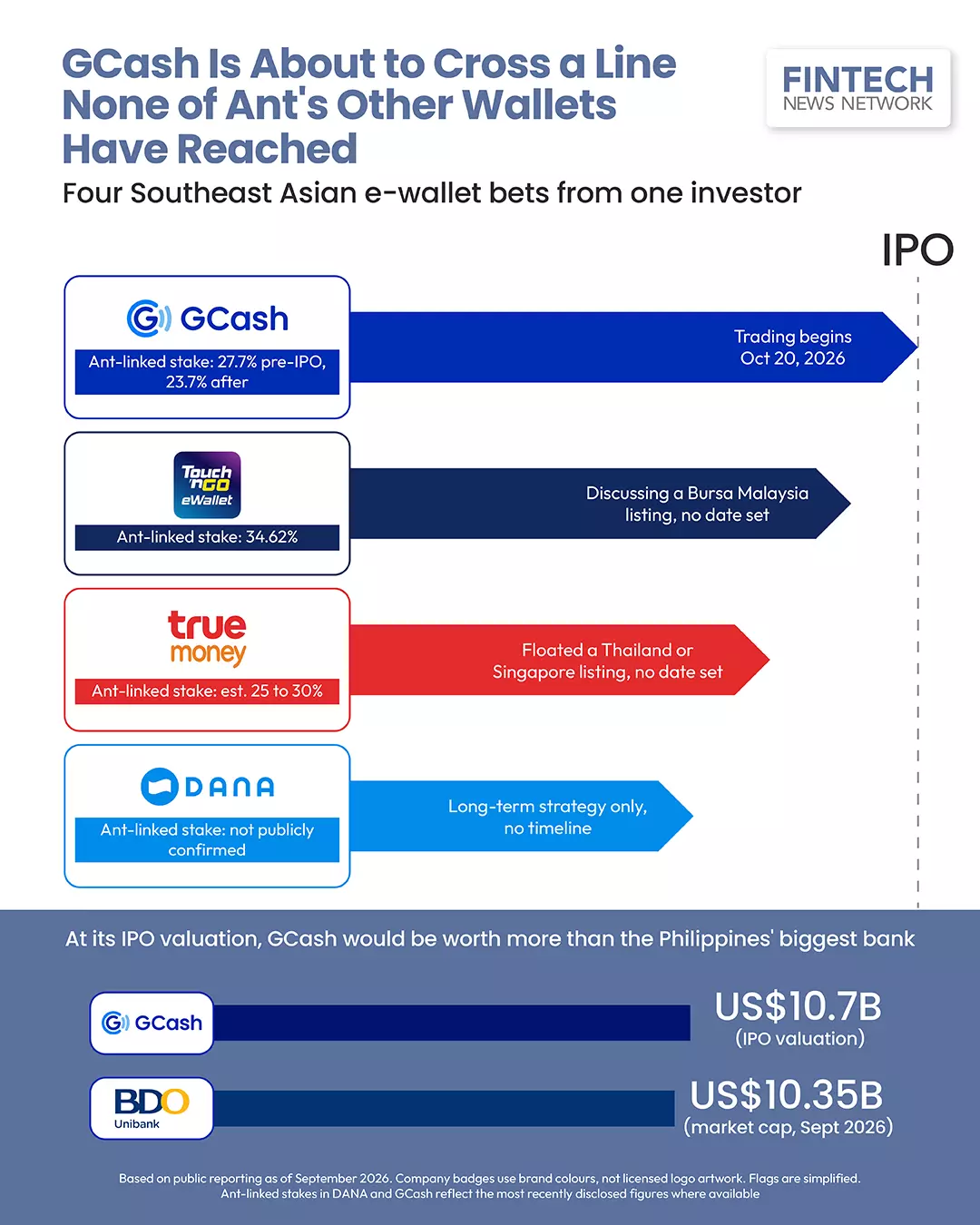
At the top of that range, the company would carry a market capitalisation of about roughly US$10.7 billion.
As it stands, it is more than what BDO Unibank, the Philippines’ largest bank, is currently worth.
The Price Tag Has Been Building for a While
That valuation comes with more transparency than most of GCash’s regional peers ever have to offer.
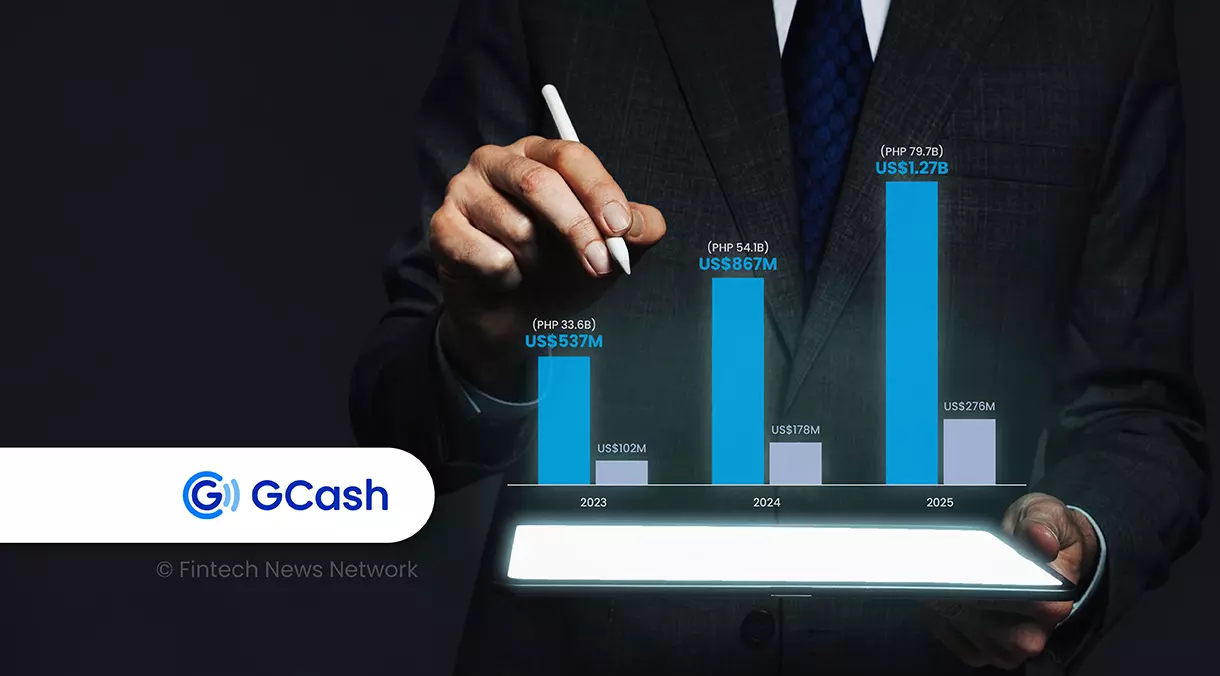
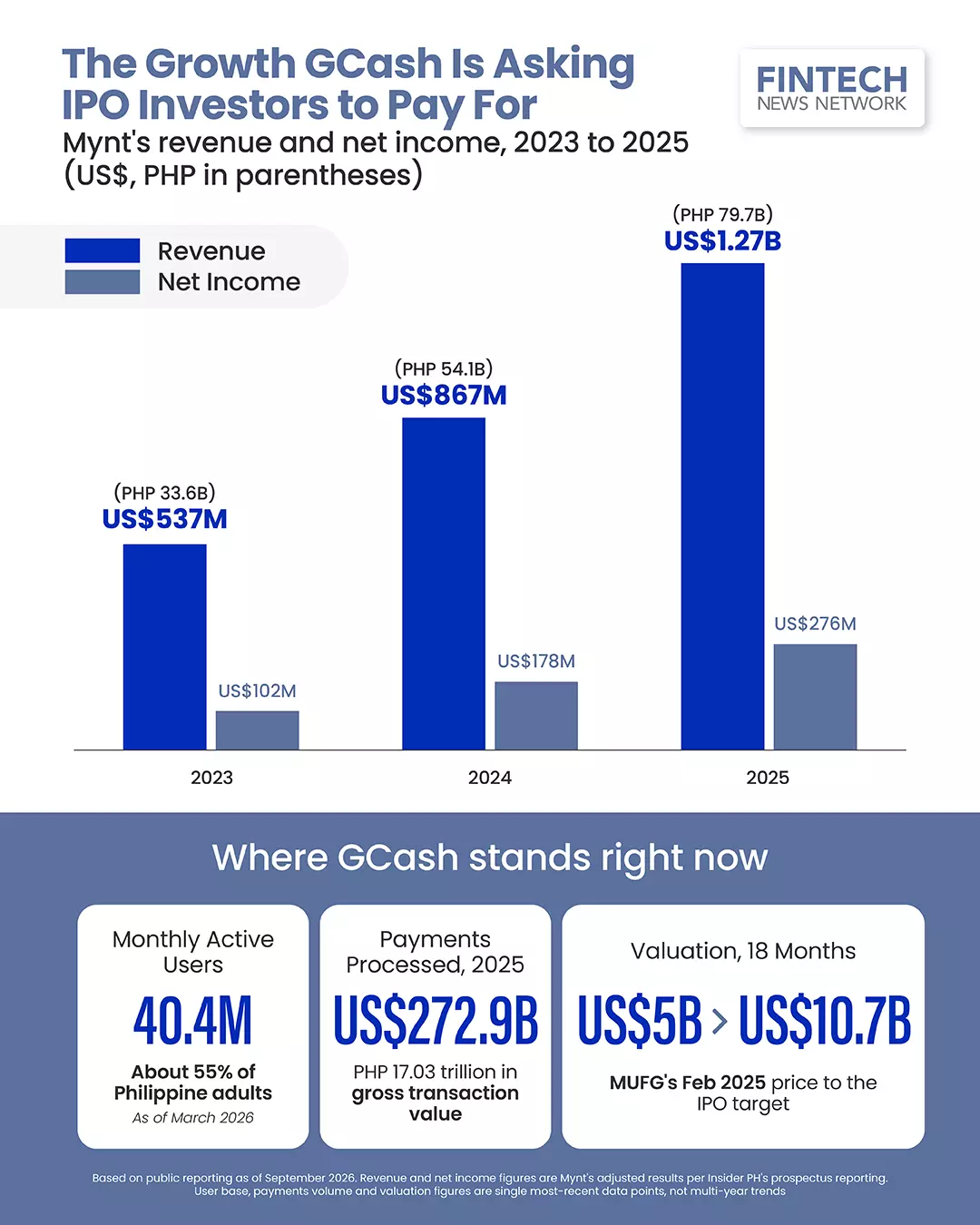
The Insider PH reported Mynt’s adjusted revenue climbing from US$537 million in 2023 to US$1.27 billion in 2025. Its net income has more than doubled to US$276 million over the same stretch.
By March 2026 the app had 40.4 million monthly active users, about 55% of Philippine adults, and its payments business alone moved US$272.9 billion in 2025.
Lending, savings, investment and insurance now sit alongside payments in the app, well beyond GCash’s original remit as a place to pay bills and buy load.
Private investors have already been pricing that growth in.
MUFG bought an 8% stake in February 2025 at a valuation of US$5 billion. Eighteen months later, the IPO would value Mynt at more than double that.
Globe Telecom holds roughly 34% of Mynt. The IPO ceiling would re-rate that stake from a US$416 million book value to something closer to US$3.48 billion.
This is assuming Globe doesn’t reduce its holding in the secondary tranche.
A private funding round only shows what a limited group of investors were prepared to pay at one point in time.
Once GCash trades, the market reassesses that price every day, which is exactly what none of Ant’s other Southeast Asian bets have had to face yet.
What’s Left of Ant’s Original Bet, and What Else It Owns
The GCash relationship dates to February 2017, when Ant Financial and Ayala signed on to invest in Mynt, then a Globe subsidiary, for a 45% stake.
Several funding rounds later, including MUFG’s entry last year, that position now sits across two entities.
Ant International Technologies (Singapore) Holding owns 21.44% and isn’t selling in the IPO.
Advanced New Technologies (Singapore) Holding owns 6.22% and is cutting that to 2.30%, cashing out up to US$403 million in the process.
Combined, that’s roughly 27.7% of Mynt before the offering, dropping to about 23.7% if the maximum sell-down goes through, down from the 45% Ant started with nine years ago.
That’s one investment. Ant holds a comparable position in three others.
In Malaysia, Ant International Technologies (HK) Holding owns 34.62% of TNG Digital, the operator of Touch ‘n Go eWallet, alongside majority owner CIMB.
Ant has backed DANA in Indonesia since an early stake through its parent Emtek. Though the exact number has shifted through several ownership changes since and isn’t public today.
DANA and Ant cited a user base of more than 200 million when the two launched a marine conservation initiative together in October 2025.
In Thailand, Ant put money into Ascend Money, the company behind TrueMoney, back in 2016.
Since then, it has been building a stake now estimated at 25 to 30%, with the business last valued around US$1.5 billion in a 2021 funding round.
Touch ‘n Go Is the Closest Comparison
Of the three private e-wallets, it seems to me like Touch ‘n Go is the closest thing to an apples-to-apples comparison.
TNG Digital has already discussed an eventual Bursa Malaysia listing. It just posted its first profitable year, too.
Revenue reached US$174 million for 2025, up 72%. Profit after tax came in at US$25 million, reversing a US$10.4 million loss the year before
CEO Alan Ni has put its verified user base at 27 million, including 23 million Malaysians, more than 85% of the country’s adult population by his account.
The company crossed a US$1 billion valuation in 2025.
Once GCash has a market price, bankers pricing a future TNG Digital listing will have an actual regional peer to measure against instead of guessing.
Even so, the comparison will never be exact. It is mainly due to how GCash operates at a much larger scale and relies far more heavily on lending.
DANA Is a Longer Way Off
DANA is a longer way off. It competes with GoPay, OVO, ShopeePay and others in a market where the leader changes depending on which metric is used.
Plus, unlike Touch ‘n Go, it hasn’t put a timeline on going public. The company only stated that it would consider a listing once conditions were right.
GCash’s price won’t tell anyone what DANA is worth.
What it can do is show investors, for the first time, roughly how the market values a large Southeast Asian wallet once it has built real revenue beyond basic payments, which is the same test DANA will eventually have to pass.
That test starts in earnest on October 20.
A strong debut would hand TNG Digital, DANA and Ascend Money’s operator a genuine reference point the next time any of them talk to bankers about their own listings.
A weak one would do the opposite, and make the case for staying private a little longer.
Either way, Manila is about to give Southeast Asia’s e-wallet sector something it has never had, an actual price.
Featured image: Edited by Fintech News Philippines based on an image by rawintanpin via Magnific.
Infographic image: Edited by Fintech News Philippines based on an image by nasimashobarna67 via Magnific.
