



Inside the convergence of agentic AI and Philippine BPO excellence that is reshaping how the world’s leading fintech companies, neobanks, payment processors, and financial institutions operate — and why the Philippines is uniquely positioned to lead this transformation.
Executive Summary
Five things every fintech decision-maker needs to know about outsourcing to the Philippines in the agentic AI era:
- Agentic AI is not replacing Philippine fintech BPO — it is accelerating it. The most sophisticated fintech operations in the world now run on hybrid human-AI systems where autonomous agents handle volume and speed, and Philippine-based specialists handle judgment, compliance oversight, and the continuous feedback loops that keep AI models performing accurately in production.
- The Philippines processes an estimated $2.2 trillion in financial transactions annually through its BPO sector, spanning KYC/AML operations, fraud investigation, intelligent document processing, regulatory reporting, and AI-augmented customer operations — making it one of the world’s most critical nodes in the global financial services supply chain.
- Agentic AI introduces a new and growing category of fintech BPO work: AI oversight, model feedback, bias auditing, and compliance monitoring of autonomous financial systems. Philippine BPO providers are rapidly building the specialist teams and processes needed to fill this role — and financial regulators are increasingly mandating it.
- The Philippines’ structural advantages for fintech BPO — English fluency, a large accounting and finance graduate pool, deep familiarity with US/UK/AU regulatory environments, mature data security infrastructure, and a government-backed fintech strategy — are amplified, not diminished, by agentic AI adoption.
- PITON-Global is the Philippines’ leading outsourcing advisory firm, with 25+ years of market presence and partnerships with the nation’s top 28 specialist BPO providers. For fintech companies evaluating Philippine outsourcing, the company provides expert-matched introductions to the right providers — entirely free of charge.
The Convergence That Is Redefining Financial Services Outsourcing
Two of the most consequential shifts in global financial services are happening simultaneously, and they are not happening in isolation. Agentic AI — autonomous systems capable of perceiving financial data, reasoning about it, taking action, and learning from outcomes without continuous human instruction — is moving from research labs into production deployments at the world’s largest banks, neobanks, payment processors, insurance companies, and capital markets firms.
At the same time, the Philippine BPO sector is undergoing its most significant evolution since the offshore customer service wave of the early 2000s, transitioning from labor-arbitrage outsourcing into a sophisticated knowledge services industry where human expertise is applied at the judgment layer of increasingly automated financial workflows.
These two shifts are not competing forces. They are convergent ones. Agentic AI creates demand for precisely the kinds of human capabilities the Philippines can provide at scale: the analytical oversight of autonomous decision systems, the continuous feedback loops that keep AI models accurate in production, the compliance monitoring that financial regulators are beginning to require of AI-driven processes, and the domain-expert judgment that resolves the edge cases that autonomous systems cannot handle reliably.
The result is a new operating model for financial services — one in which the Philippines is not being displaced by AI but is becoming more deeply embedded in the AI-powered financial services stack.
Understanding this convergence requires looking carefully at what agentic AI actually does in a fintech context, where it succeeds, where it fails, and why those failure points create enduring and growing demand for the kind of human talent the Philippines has in abundance.
What Agentic AI Actually Means for Financial Services Operations
The term ‘agentic AI’ is used with varying precision in financial services commentary. Agentic AI refers to systems that go beyond pattern recognition and prediction to take autonomous action within a defined operational environment — systems that can read a loan application, assess risk against a multi-factor model, request additional documentation, flag potential fraud, and initiate a decision workflow without a human issuing instructions at each step.
This is qualitatively different from the machine learning models that financial institutions have been deploying for credit scoring and fraud detection for the past decade. Traditional ML models produce outputs — scores, probabilities, classifications — that humans then act upon.
Agentic AI systems produce outputs and act upon them, closing the loop between perception, decision, and execution in ways that compress cycle times by orders of magnitude and enable financial operations to scale without proportional headcount growth.
The Four Layers of Agentic AI in Financial Operations
Agentic AI in financial services operates across four functional layers, each of which creates distinct roles for human oversight and Philippine BPO expertise. The perception layer ingests and classifies financial data — documents, transactions, communications, identity signals — at speeds and volumes that no human workforce can match. The reasoning layer applies learned and rule-based logic to make decisions: approve or decline, flag or clear, escalate or resolve.
The action layer executes those decisions — initiating payments, filing regulatory reports, updating customer records, triggering alerts. And the learning layer incorporates outcomes and feedback to improve future performance, which is where the human-in-the-loop role becomes most consequential.
The learning layer is the least understood and most strategically important of the four. Agentic financial AI systems do not arrive at production in a finished state. They degrade without continuous feedback. They develop biases when the distribution of real-world cases shifts away from their training data.
They make systematic errors in edge cases that only domain-expert humans can identify. The country’s BPO workforce — with its combination of financial education, English language depth, and quality-culture conditioning — is exceptionally well positioned to staff the human-in-the-loop roles that keep agentic financial AI performing accurately in production.

According to John Maczynski, CEO of PITON-Global and a leading authority on fintech outsourcing in the Philippines,
“The narrative that AI will replace fintech BPO fundamentally misinterprets how financial AI operates in real-world production environments. Agentic systems require continuous human oversight, correction, and feedback to maintain accuracy and ensure compliance—particularly in financial services, where regulatory frameworks and fraud patterns are constantly evolving.
What we are observing in the Philippine market is not displacement, but transformation. There is a growing demand for a more sophisticated class of fintech front- and back-office roles—focused on the oversight, training, and governance of AI systems themselves.”
The Philippine Structural Advantage in Fintech BPO: Why This Market Leads
A Finance Graduate Pipeline Built for the Modern Financial Stack
The Philippines produces over 80,000 accounting and finance graduates annually — one of the largest such pipelines in Asia relative to population. This is not incidental to the country’s fintech BPO leadership; it is foundational to it. KYC and AML operations require analysts who understand the regulatory logic of sanctions screening and beneficial ownership structures, not just the procedural steps of a checklist.
Fraud investigation requires people who can understand financial statement manipulation and account behavior patterns at a conceptual level, not just flag rule-based anomalies. Credit underwriting support requires analysts who understand how risk factors interact across a loan portfolio, not just how to enter data into a template.
The local finance graduate pool supplies all of these capabilities — and at a volume that no comparable English-speaking outsourcing destination can match. Combined with CPA certification rates that consistently rank among the highest in Asia, and with a professional culture shaped by decades of exposure to US GAAP, IFRS, and international financial reporting standards through the country’s Big Four accounting firm presence, the Philippines offers financial services companies a depth of domain expertise that goes well beyond what general BPO cost arbitrage can explain.
Deep Regulatory Familiarity Across the Fintech Stack
Outsourcing providers serving the fintech sector have developed operational familiarity with an unusually broad range of international regulatory frameworks: US Bank Secrecy Act and FinCEN requirements; UK FCA conduct rules; EU PSD2, GDPR, and MiCA cryptocurrency regulation; MAS regulatory guidance for Singapore-licensed fintechs; and AUSTRAC AML/CTF requirements for Australian financial services.
This multi-jurisdictional regulatory fluency — built through years of serving US, UK, EU, and APAC financial services clients — is the type of institutional knowledge that takes years to accumulate and cannot be replicated quickly in alternative markets.
For financial technology companies whose compliance obligations span multiple jurisdictions — a common reality for payment processors, stablecoin operators, digital lending platforms, and cross-border remittance providers — this regulatory breadth is not a nice-to-have. It is a prerequisite for selecting a BPO partner.
Data Security Architecture Aligned to Financial Services Requirements
Financial services data is among the most sensitive and heavily regulated data in existence. PII associated with financial accounts, transaction records, credit history, identity documents, and beneficial ownership information carries compliance obligations under dozens of regulatory frameworks simultaneously.
Philippine BPO providers serving fintech clients have invested accordingly: SOC 2 Type II certification, PCI-DSS compliance for payment data environments, ISO 27001 information security management systems, clean-room annotation and processing environments with full access logging, and physical security controls that satisfy the due diligence requirements of Fortune 500 financial services compliance teams.

“Companies come to us with compliance requirements that would eliminate 95% of global BPO providers immediately. SOC 2 Type II, PCI-DSS, ISO 27001, GDPR-compliant cross-border data transfer frameworks, BSP alignment for any data touching Philippine banking systems — the top Philippine providers have invested in meeting all of these simultaneously, because that is what the international fintech market demands. Decades of working with BPOs have taught us which providers have genuinely built this infrastructure versus which ones have it on a slide deck,”
states Ralf Ellspermann, CSO of PITON-Global.
Agentic AI in Philippine Fintech Outsourcing: Use Cases, Roles, and Impact
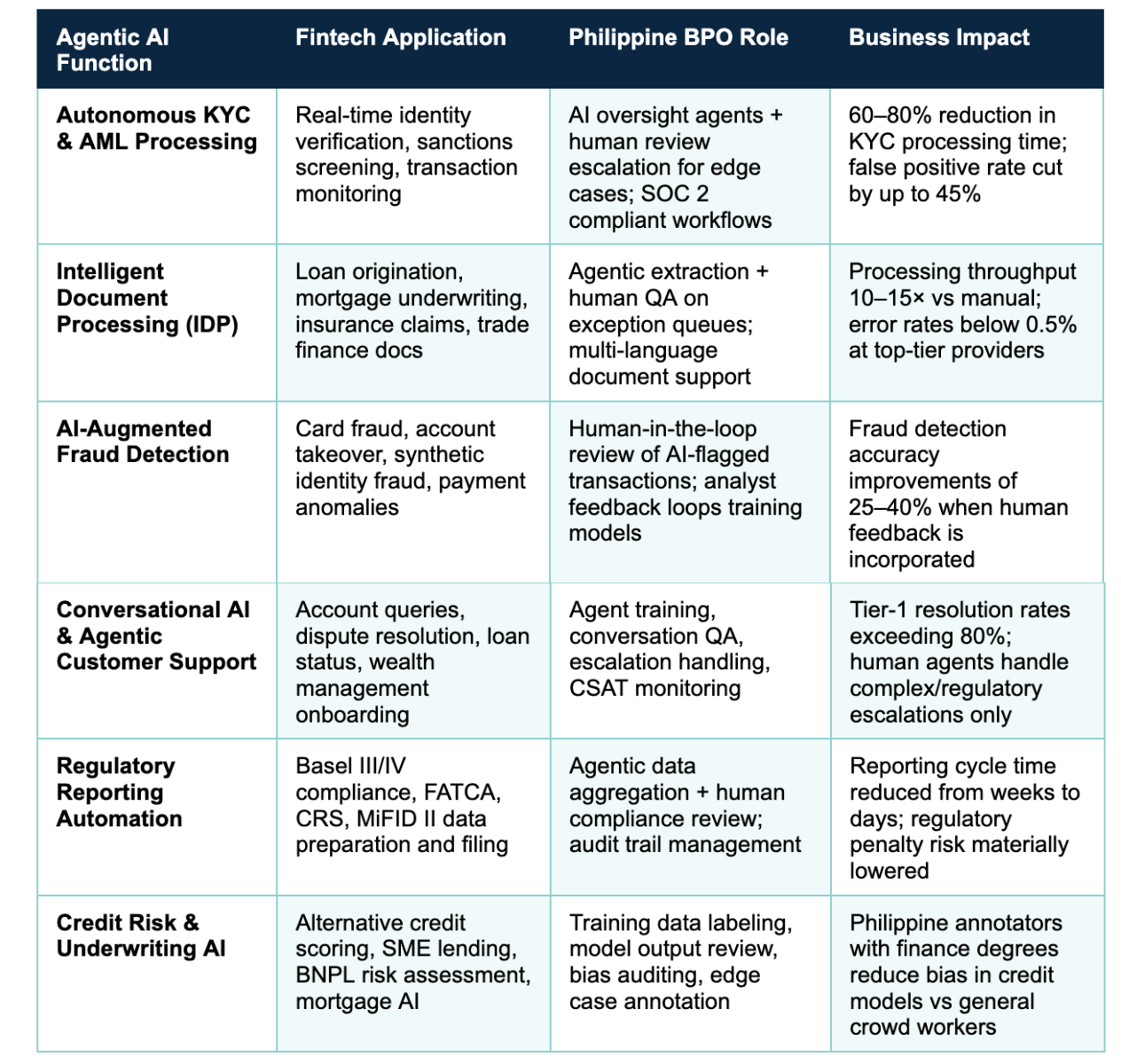
The following table maps the six most significant agentic AI use cases currently deployed in Philippine fintech BPO operations, defining the specific role Philippine human workers play in each workflow and the documented business impact these hybrid human-AI operations deliver.
Table 1: Agentic AI Use Cases in Fintech Outsourcing — Roles and Measured Impact
The Agentic AI Stack in Financial Services: Where Humans Are Irreplaceable
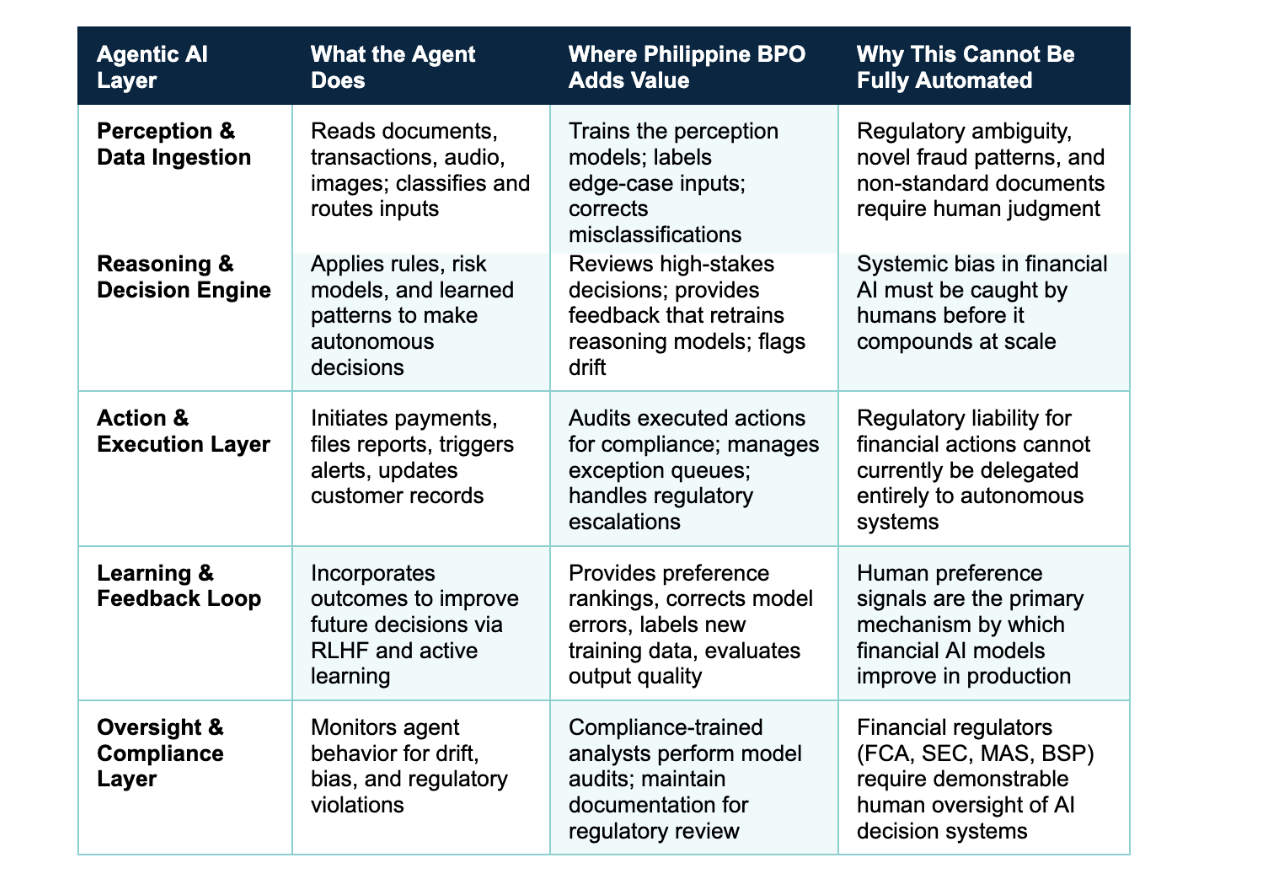
One of the most important — and most misunderstood — aspects of agentic AI deployment in financial services is the regulatory and practical reality that autonomous systems cannot operate without documented human oversight. This is not a transitional constraint that will dissolve as AI improves. It is a structural feature of financial services regulation that reflects decades of hard-won understanding about what happens when financial decision-making is delegated without accountability.
The UK Financial Conduct Authority, the US Office of the Comptroller of the Currency, the Monetary Authority of Singapore, the European Banking Authority, and the Bangko Sentral ng Pilipinas have each issued guidance — at varying levels of specificity — requiring financial institutions to maintain demonstrable human oversight of AI decision systems, particularly in credit, fraud, and AML applications. This regulatory requirement creates a structural floor beneath the human-in-the-loop fintech BPO market that will not be eroded by AI capability improvements alone.
Table 2: The Agentic AI Stack — Human Oversight Roles Across Each Layer
The Model Drift Problem: Why AI Oversight Is a Growth Industry
Among practitioners who deploy financial AI in production, model drift is one of the most consistently underestimated operational challenges. Financial markets, fraud patterns, regulatory requirements, and customer behavior are not static. A credit risk model trained on pre-pandemic consumer behavior performs differently on post-pandemic data.
A fraud detection system trained on card-present transaction patterns requires continuous retraining as contactless and digital payment volumes shift. An AML model calibrated for traditional correspondent banking patterns will generate increasing numbers of false positives and false negatives as crypto-adjacent financial flows grow.
Managing model drift in production financial AI systems requires a permanent human feedback infrastructure: analysts who review flagged cases, identify systematic errors, label new training data, and provide the preference signals that retrain models toward current operational reality. This is not a project with an end date. It is an ongoing operational function — and one that is growing in scope as financial institutions deploy more agentic AI systems across more functions simultaneously.
For Philippine BPO providers with the right talent and quality management infrastructure, model drift management represents one of the most durable growth opportunities in the current AI cycle.
Philippine Fintech BPO Capability Assessment: The Full Service Matrix
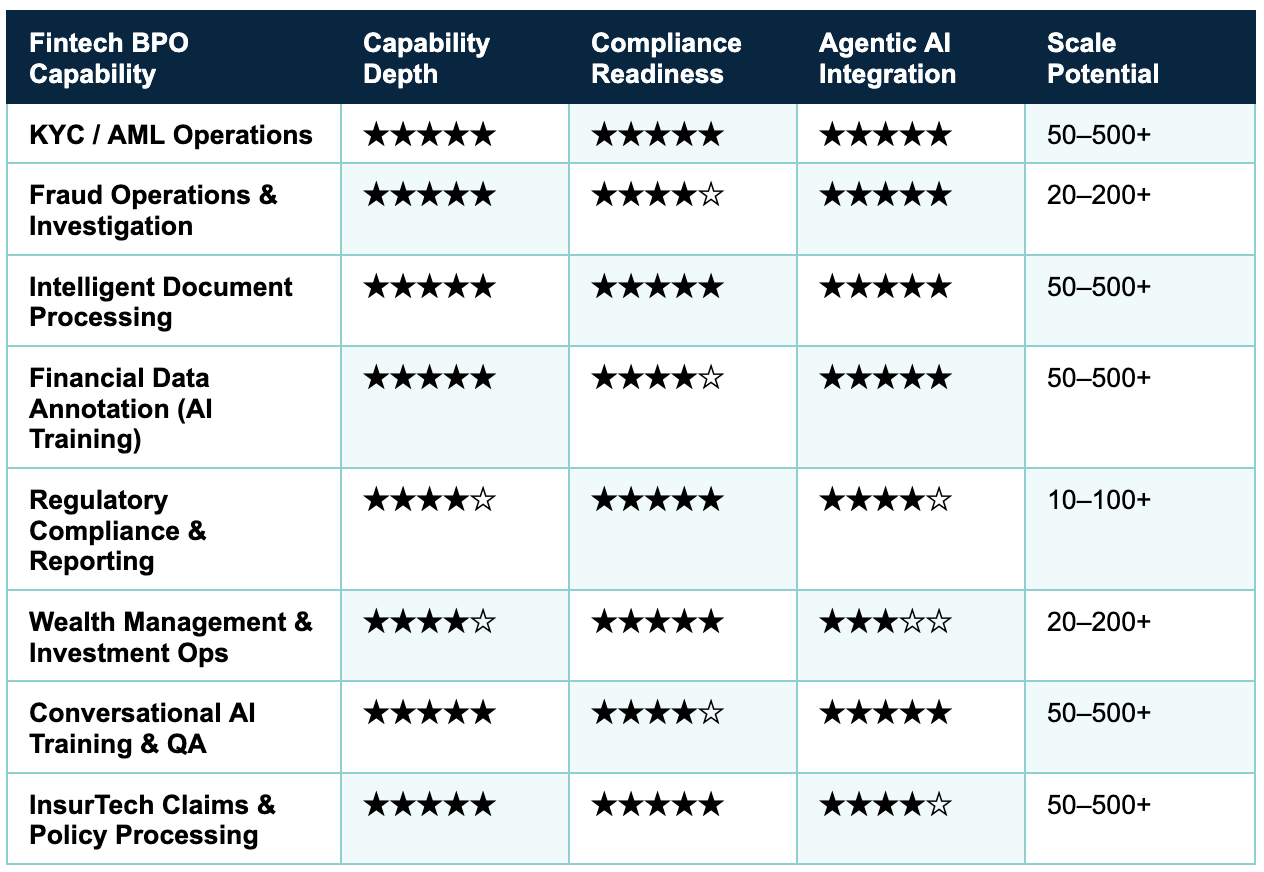
The matrix below provides a comprehensive assessment of Philippine BPO capability across the eight most significant fintech outsourcing service categories, evaluated across four dimensions: capability depth, compliance readiness, agentic AI integration maturity, and available scale.
Table 3: PH Fintech BPO Capability Matrix — Service Category Assessment
The BSP Fintech Framework: How the Philippine Regulator Is Accelerating the Sector
The Bangko Sentral ng Pilipinas — the Philippine central bank — has emerged as one of the most progressive financial regulators in Southeast Asia with respect to fintech and digital financial services.
The BSP’s Digital Payments Transformation Roadmap, its regulatory sandbox framework for fintech innovation, its open finance framework mandating API-based data portability, and its recent guidance on AI governance in financial services have collectively created a regulatory environment that is simultaneously supportive of fintech innovation and aligned with the oversight requirements of international financial institutions.
For international fintech companies outsourcing to the Philippines, BSP alignment matters in several concrete ways. Philippine BPO providers operating in the financial services sector are subject to BSP oversight requirements that mirror — and in some cases exceed — the standards applied by UK and US financial regulators.
This means that a Philippine fintech BPO provider’s compliance infrastructure is not built solely to satisfy client requests; it is built to satisfy domestic regulatory requirements as well. The result is a compliance culture that is embedded in operations rather than bolted on.
The BSP has also been an active driver of financial inclusion technology, with its InstaPay and PESONet payment rails processing billions in transactions monthly, and its e-money and digital banking licensing frameworks attracting over 50 digital bank license applications as of 2024.
This domestic fintech ecosystem has created a talent pool of operations professionals with direct, hands-on experience in digital financial services — annotators, QA specialists, compliance analysts, and fraud investigators who understand fintech operations from the inside, not just as abstract processes.
“The BSP’s fintech regulatory posture is genuinely one of the most underappreciated advantages the Philippines offers to international fintech companies. When you outsource operations to a Philippine provider, you are working with a team that is already operating under a sophisticated domestic financial regulatory framework — one that requires real compliance infrastructure, not just policy documents. That institutional discipline carries directly into how these teams handle international client compliance requirements,”
explains Maczynski.
PITON-Global: Connecting Fintechs with the Philippines’ Best BPO Providers
The Philippine fintech BPO market’s rapid evolution — from traditional back-office processing toward agentic AI oversight, model governance, and specialist compliance operations — has made provider selection significantly more consequential than it was a decade ago. A provider that excels at high-volume document processing may lack the specialist talent needed for RLHF-based model training.
A provider with strong KYC credentials may not have the technical infrastructure to integrate with agentic AI platforms. A provider with excellent compliance architecture may not have scaled beyond a few hundred analysts, making it unsuitable for programs requiring rapid growth to thousands of seats.
PITON-Global has spent a quarter of a century building the market intelligence needed to navigate these distinctions. As the Philippines’ leading outsourcing advisory firm, the company connects fintechs— from early-stage neobanks to Tier 1 global financial institutions — with the top 1% of Philippine BPO providers who have the verified capability to meet the most demanding fintech outsourcing requirements. The firm’s advisory and supplier sourcing services are provided entirely free of charge to clients.
PITON-Global’s active partner network includes 28 industry-leading BPOs that specialize in financial technology and have been evaluated against the firm’s proprietary assessment framework covering regulatory compliance architecture, AI platform integration maturity, domain expertise depth in financial services, quality management systems, attrition rates, and evidence of successful delivery to international fintech clients.
For digital innovators and disruptors entering the Philippine market for the first time, or those seeking to upgrade from an underperforming existing provider, PITON-Global’s unrivaled knowledge base compresses what would otherwise be a multi-month provider search and evaluation process into less than 4 weeks.
The Growth Trajectory: Why Philippine Fintech BPO Is Accelerating
The Philippine fintech BPO market is not growing incrementally. It is compounding. Three structural drivers are simultaneously amplifying each other in ways that make the current growth trajectory difficult to extrapolate from historical BPO patterns.
Driver 1: Global Fintech Compliance Burden Is Expanding Faster Than Headcount
The compliance cost of operating a financial services business has grown by an estimated 15–20% annually since 2018, driven by expanding AML requirements, digital asset regulation, data privacy obligations, consumer protection frameworks, and the post-2023 wave of AI governance requirements.
At the same time, the supply of qualified compliance professionals in developed markets is structurally constrained. The result is a compliance labor gap that only offshore delivery can close at scale — and the Philippines, with its regulatory familiarity and finance graduate pipeline, is the primary beneficiary.
Driver 2: Agentic AI Creates New Categories of Human Work Faster Than It Eliminates Old Ones
Each new agentic AI system deployed in a financial institution creates a set of ongoing human oversight requirements that did not previously exist: model monitoring, drift detection, feedback labeling, bias auditing, exception handling, and regulatory documentation.
As financial institutions accelerate agentic AI deployments across functions — driven by competitive pressure and the demonstrated ROI of hybrid human-AI operations — the aggregate human oversight requirement is growing, not shrinking. Conservative estimates from McKinsey’s Financial Services Practice suggest that for every 10 routine financial processes automated by agentic AI, approximately 3–4 new oversight and governance roles are created, many of which are well-suited to Philippine BPO delivery.
Driver 3: The Philippines’ Own Digital Financial Ecosystem Is Creating Domestic AI Training Data Demand
The nation’s rapid domestic fintech adoption — over 56% of adult Filipinos now hold digital payment accounts as of 2024, up from 29% in 2019 — is generating massive volumes of transaction data, customer interaction data, and fraud event data that require annotation, labeling, and governance infrastructure to be useful for AI model training. International fintech companies operating in the Philippine market and domestic banks building AI capabilities are both sourcing annotation and AI training services from the same Philippine BPO providers — creating a self-reinforcing domestic demand signal that adds resilience to the sector’s growth profile.
The Philippines Is the Human Layer Powering AI-Driven Finance
The financial services industry is undergoing the most significant operational transformation since the introduction of electronic trading. Agentic AI is compressing cycle times, eliminating routine processing, and enabling financial institutions to operate at a scale and speed that would have been operationally impossible a decade ago.
But this transformation is not producing a world without human workers in financial operations. It is producing a world where human workers are concentrated at the highest-value points in the financial AI stack: judgment, oversight, governance, and the continuous feedback loops that keep autonomous systems aligned with operational reality.
The Philippines — with its English-language depth, its finance and accounting graduate pipeline, its mature and compliance-ready BPO infrastructure, its BSP-aligned regulatory culture, and its 30-year track record of serving the world’s most demanding financial institutions — is better positioned than any other outsourcing market to supply the human layer that agentic AI-powered financial services requires.
Companies that recognize this now and that build their BPO partnerships with the right providers and the right guidance will hold structural advantages in compliance cost, AI model quality, and operational resilience that will compound for years.
PITON-Global exists to make those partnerships happen faster, with greater precision, and at zero cost to the organizations that need them most.
Featured image by PITON-Global
